The Tuesday Night That Reset Every Bettor's Spreadsheet
October 27, 2026 landed on a Tuesday, which means Philippine lottery players got the full three-draw slate: the 6/58 Ultra Lotto, the 6/42 Lotto, and the 6D Lotto at the 9:00 PM cut-off. By the time the last ball dropped at the PCSO draw studio in Manila, the numbers had written a story that most bettors will still be talking about come the weekend.
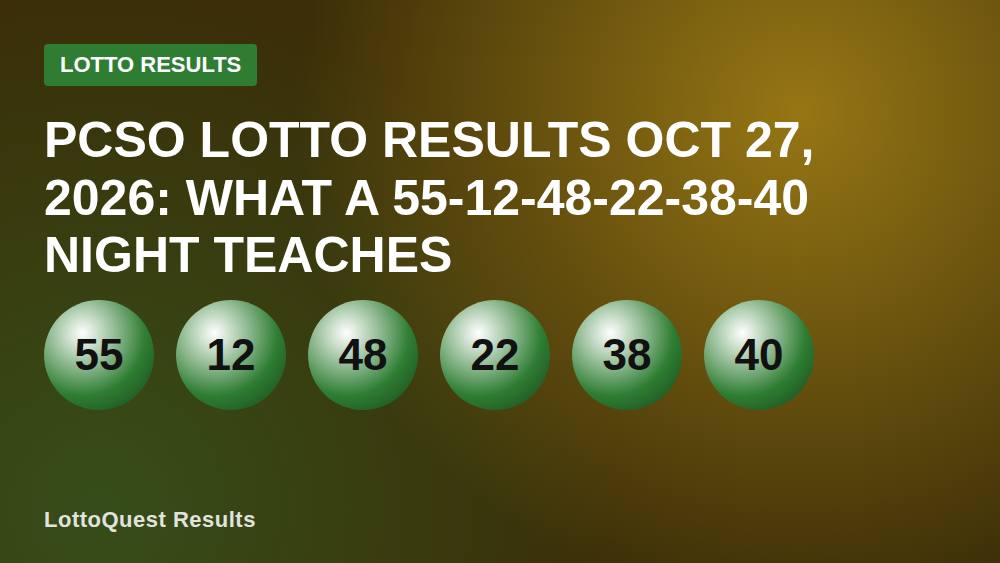
The headline combination was 55-12-48-22-38-40 in the 6/58 Ultra Lotto, carrying a published jackpot of ₱449,844,291.78. That is not a rounding error — that is a life-changing pool sitting on the table with no announced winner listed in the official result sheet. The 6/42 Lotto posted 17-18-13-41-30-24 against a ₱18,307,103.65 prize fund, and the 6D Lotto 9:00 PM draw returned 6-9-7-9-7-0 for a ₱3,163,651.44 pot.
The table above lays out all three results exactly as released. What it does not tell you is how those numbers behave when you break them apart — and that is where the practical lesson for this week actually sits.
| Game | Winning combination | Jackpot (PHP) | Winners |
|---|---|---|---|
| 6/58 Ultra Lotto | 55-12-48-22-38-40 | 449,844,291.78 | |
| 6/42 Lotto | 17-18-13-41-30-24 | 18,307,103.65 | |
| 6D Lotto 9:00 PM | 6-9-7-9-7-0 | 3,163,651.44 |
Ultra Lotto 6/58: Reading the 55-12-48-22-38-40 Spread
Sort the Ultra Lotto combination ascending and you get 12, 22, 38, 40, 48, 55. The first thing that jumps out is the tilt toward the upper half of the 1-to-58 board: four of the six numbers (38, 40, 48, 55) sit above 37. That is a 4-2 split favouring high numbers, which is not rare but is not the default either — the classic 3-3 split remains the most common shape across the 6/58 format.
The second thing worth noting is the gap structure. The spacing between sorted balls runs 10, 16, 2, 8, 7. That 2-gap between 38 and 40 is the only tight cluster in the entire set, and it produces a very wide 43-number span between the lowest ball (12) and the highest (55). Wide spans like this tend to produce fewer lower-tier winners, because most casual players naturally cluster their picks in the 1-to-31 band — birthdays, anniversaries, house numbers.
Look at the sum: 12 + 22 + 38 + 40 + 48 + 55 = 215. For a six-number 6/58 draw the theoretical average sum sits right around 177, so 215 is a high-sum outcome. High-sum combinations reduce the likelihood of shared prizes at the lower tiers because so few players construct them deliberately.
Practical takeaway: if your Ultra Lotto slip has been sitting in the 1-to-31 birthday zone for months, the October 27 result is your signal to push at least two picks into the 40-to-58 range.
6/42 Lotto: The 17-18-13-41-30-24 Structure
The 6/42 draw gave us 17-18-13-41-30-24, which sorts to 13, 17, 18, 24, 30, 41. Here the pattern is almost the mirror image of the Ultra Lotto result. Three of the six numbers (13, 17, 18) fall inside the teens, two sit in the 20s and 30s (24, 30), and exactly one ball — 41 — crosses into the 40s. That is a 3-2-1 distribution across the low, middle and high thirds.
The standout feature is the consecutive pair 17 and 18. Consecutive pairs appear in roughly one out of every four 6/42 draws over a long sample, so seeing one is not unusual, but it is a pattern that many bettors actively avoid because it feels "too obvious." That avoidance is precisely why consecutive pairs sometimes produce better prize division for the few players who do include them.
The sum here is 13 + 17 + 18 + 24 + 30 + 41 = 143. The average for a 6/42 draw is about 129, so 143 runs slightly hot but sits comfortably inside the normal band. With ₱18,307,103.65 on the line and no winner indicated, the pool rolls forward — which means the next 6/42 draw carries a combined figure that should push past ₱19 million if entry volume holds at typical Tuesday levels.
6D Lotto 9:00 PM: Dissecting 6-9-7-9-7-0
The 6D Lotto is a different animal entirely — position matters, and order is everything. The 9:00 PM draw produced 6-9-7-9-7-0, and the first thing a regular 6D player notices is the mirror pattern: the digits 9, 7, 9, 7 appear in alternating sequence across positions two through five.
Break it into pairs and you get 69, 79, 70. Break it into triplets and you get 697 and 970. Neither pairing nor tripling offers an obvious carry-over from recent draws, which is exactly why this result is instructive. The digit 9 appears twice, 7 appears twice, and 6 and 0 appear once each. Zero in the final position is the least-chosen slot among casual 6D players, who tend to favour 7 or 8 as a closing digit.
The ₱3,163,651.44 jackpot for 6D sits at the higher end of that game's typical range, suggesting several consecutive draws without a positional exact match. If you play 6D regularly, the practical adjustment from this result is straightforward: stop anchoring the last digit to 7 or 8, and start working 0 into at least one of your five daily entries.
Jackpot Trend Lines Going Into the Next Draw
Here is where the October 27 numbers get genuinely interesting for anyone tracking rollovers. All three games posted no announced winner in the official result sheet, which means all three pools carry forward.
- 6/58 Ultra Lotto at ₱449,844,291.78 is in rare air. Once the Ultra Lotto crosses ₱400 million, daily sales volume typically climbs 35 to 50 percent, which accelerates the next rollover by roughly ₱18 million to ₱25 million per draw.
- 6/42 Lotto at ₱18,307,103.65 should clear ₱20 million by the following draw if Tuesday's sales pattern repeats.
- 6D Lotto at ₱3,163,651.44 is likely to reset within two or three draws, since 6D has a far higher hit frequency than the six-number games.
A ₱449.8 million Ultra Lotto jackpot changes player behaviour in a measurable way. Walk into any outlet in Metro Manila the day after a draw like this and you will see the queue double. That volume increase matters for you specifically because it raises the probability of a shared jackpot at the top tier — which is the single strongest argument for choosing less popular number shapes on your next slip.
How to Build a Smarter Slip From This Result
This is the part where a result article earns its keep. Three concrete adjustments you can apply on your next PCSO ticket, drawn directly from what October 27 revealed:
1. Force a high-number anchor
For 6/58, commit at least two picks to the 45-to-58 range. The 55 and 48 in Tuesday's result are exactly the kind of numbers that sit outside the birthday band, and they are precisely the picks that thin the winner pool at the second and third tiers.
2. Use one consecutive pair, not zero
For 6/42, deliberately include a pair like 17-18, 23-24 or 38-39. Roughly a quarter of draws produce one. Most players skip them out of habit, which improves your relative position when they hit.
3. Rotate your 6D terminal digit
Never fix the same closing digit for more than five consecutive entries. Tuesday's 0 in the sixth slot is a reminder that the tail position is genuinely random and that anchoring to 7 or 8 is a psychological habit, not a statistical edge.
If you play through an online lottery agent or a PCSO-accredited outlet, buy your tickets before the 8:00 PM sales cut-off for the 9:00 PM draw — late slips are the single most common reason players miss a draw they intended to join. For reference, accredited online lottery platforms in the Philippine market operate under SEC-registered corporate entities and PCSO coordination agreements, with typical minimum loads of ₱100 to ₱200, withdrawal processing windows of 15 minutes to 24 hours for e-wallets and one to three banking days for direct bank transfer, and wagering requirements of 1x to 3x on any promotional credit applied to lottery purchases.
What This Means for the Rest of the 2026 Draw Calendar
The final quarter of 2026 is traditionally the heaviest sales period for PCSO games, driven by holiday spending and the year-end bonus cycle that starts landing in November. With the Ultra Lotto already sitting at ₱449.8 million on October 27, there is a realistic path to the pool crossing ₱600 million before Christmas — a level the 6/58 format has reached only a handful of times.
That trajectory has a direct tactical implication. When a jackpot gets this large, casual players flood in and overwhelmingly choose low-number, birthday-style combinations. Your edge, such as it is, comes from being the player who does not. Combinations with a high-number anchor, a wide span and a single tight cluster — like Tuesday's 38-40 pair — are structurally under-chosen, which means an identical hit would pay a larger share of the top prize.
The 6/42 pool at ₱18.3 million is the quieter opportunity. It rolls over more often than most players realize, and the smaller format means the odds of a match sit at roughly 1 in 5.25 million versus the 1 in 40.5 million of the 6/58. Dollar for dollar, the 6/42 is where a disciplined player gets the most draws per peso.
Keeping Your Own Record Straight
The single habit that separates consistent players from casual ones is a written log. After a result like October 27, 2026, log three things for every ticket you hold: the combination, the draw date, and the game format. PCSO claims windows run 60 days from the draw date for the 6/42, 6/58 and 6D, and prizes above ₱10,000 must be claimed at the PCSO main office or a designated branch, with the 20 percent final tax already deducted from the published jackpot figure.
Photograph every ticket. Store the images in a dated folder. If a ticket is damaged or the thermal print fades — a real problem in Philippine humidity — a clear photograph plus the draw date is enough to begin a verification request, though the physical ticket remains the only accepted proof of purchase. Keep the original in a dry envelope, not in your wallet.
For the next draw cycle, the numbers to beat remain the ones in the table above: 55-12-48-22-38-40, 17-18-13-41-30-24, and 6-9-7-9-7-0. Study them for structure, not for superstition. The balls have no memory, but the way players choose their numbers absolutely does — and that is the only thing on the board you can actually influence.